
Now that summer has officially come to a close, I’ve been reflecting on one of its highlights: the fireflies. Anyone who has ever chased a firefly remembers their first time. You are young, dusk has just fallen, and a light floats up out of the grass as the whole world narrows around that one flashing point. You cup your hands around it, trying to hold onto its magic, but the light escapes between your fingers. This magical—almost ethereal—hour may surely be the moment many of us first understood that the dark is not empty.
I learned the Balinese word for that hour from Wayan Wardika, a conservationist who founded a firefly lab on his family’s land in Taro Village, located twenty minutes outside Ubud, a town in Indonesia that’s considered Bali’s epicenter of spirituality and art. That word is Sandhya. It refers to the soft junction between day and night, when the light drains from the sky and the paddies—the country’s emblematic rice fields tended to by farmers for generations—reflect the minimal moonlight and start blinking back. He talks about it the way most people talk about their first love.
I was in Bali on a rare trip with no agenda, which is how I ended up standing in a rice paddy at dusk, listening to the sound of crickets waking up, and waiting for the lights.
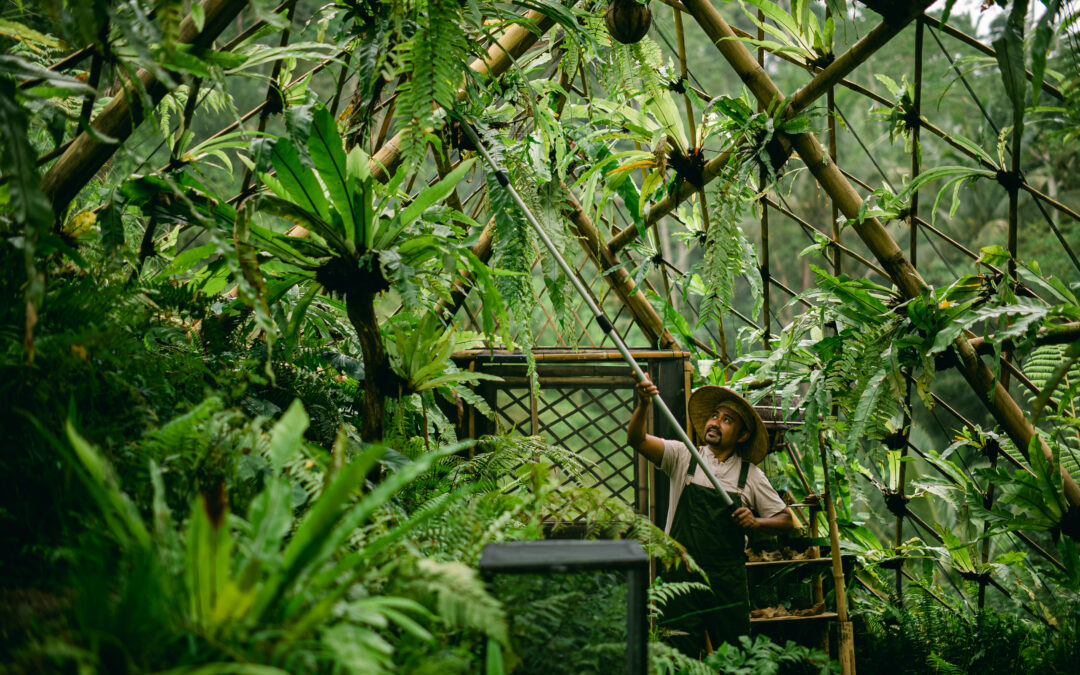
Wardika grew up in Taro without electricity. He’d walk home from school on a path lit only by firefly light, the rice paddies filling up with water the way a night sky opens to reveal its stars. He left his hometown at the age of 25 for a career in hospitality, working in hotel lobbies and on cruise ships that never went dark. When he came home two decades later, the paddies were still there, but the firefly light that used to move through them was gone.
According to the International Union for Conservation of Nature’s (IUCN) Red List of Threatened Species, one in three firefly species in North America is on the verge of extinction, and 14 percent of species are considered threatened. A number of species in Indonesia, Thailand, and Malaysia are listed as vulnerable.
In an effort to rebuild the firefly populations in his hometown, Wardika spent his savings to build a research lab and hired a small staff of biologists and scientists to uncover the reason behind the eerie disappearance of light. The answer, mostly, was—us.
The magic of a firefly’s glow, it turns out, is a chemical reaction known as bioluminescence. It is as specific as it is fragile. A firefly’s flash is a courtship signal; luciferase, luciferin, and oxygen combine into cold light. It’s deemed cold because, as far as heat-emitting light sources go, firefly flashes don’t produce much warmth. Males take to the air, flashing to attract a mate. Females flash back from their perches, turning chemistry into courtship. It is a conversation that only works in the dark. Put a streetlamp over it and the whole exchange vanishes.
Our human bodies run a version of the same conversation. Specialized cells in the eye, called intrinsically photosensitive retinal ganglion cells, exist mainly to tell the brain whether it’s day or night. They report to the suprachiasmatic nucleus, the body’s master clock, which decides when melatonin is released. Like the firefly’s flash, that signal only works in the dark. Flood the room with light, and the firefly can’t find a mate, and our brain doesn’t signal to us that it’s time to sleep.
The remainder of this article can be found on outsideonline.com.
Ingrid Yang, MD, is a board-certified internist who specializes in longevity. She’s also a travel journalist and yoga teacher who journeyed to Vietnam in search of the perfect yoga retreat and said that her trip to Sardinia, Italy, changed her perspective on aging. During a visit to Indonesia, she met firefly conservationist Wayan Wardika and noticed an eerie parallel between declining firefly populations and human longevity. Here’s what she uncovered during her stay.